Bosch washing machines are known for their reliability, but like any appliance, they may encounter issues from time to time. When an error occurs, your machine will display a code to help identify the problem.
This guide covers the most common Bosch laundry error codes, explaining what they mean and offering troubleshooting tips you can try at home. Whether you’re dealing with a drainage issue, door lock problem, or heating element failure, we’ll walk you through simple steps to resolve it. And if the issue persists, we’ll help you know when to call a professional technician to get your washing machine back to peak performance.
Error Codes E16 / F16 & E36 / F36: Door Lock Faults
These safety interlock codes prevent the machine from operating while the door is open, but they differentiate between a mechanical user error and a deep electrical failure.
-
E16 / F16 (Mechanical Impedance):
-
Symptoms: The door fails to latch properly with an audible click, and the cycle refuses to start.
-
Cause: An overloaded drum pushing laundry against the glass, or a small item (like a sock) trapped over the rubber door seal, physically preventing the metal striker from engaging the lock.
-
What to do: Pause the machine, remove any trapped clothing, reduce the load size, and shut the door firmly until you hear a loud mechanical click.
-
-
E36 / F36 (Electrical Circuit Failure):
-
Symptoms: The door physically clicks shut, but the E36 code appears, and the machine will not start.
-
Cause: The internal PTC bimetallic coil inside the door lock has burnt out, the wiring harness is fractured, or the control board is failing to send voltage to the lock.
-
What to do: A multimeter continuity test is required. The faulty door lock mechanism assembly generally needs to be completely replaced.
-
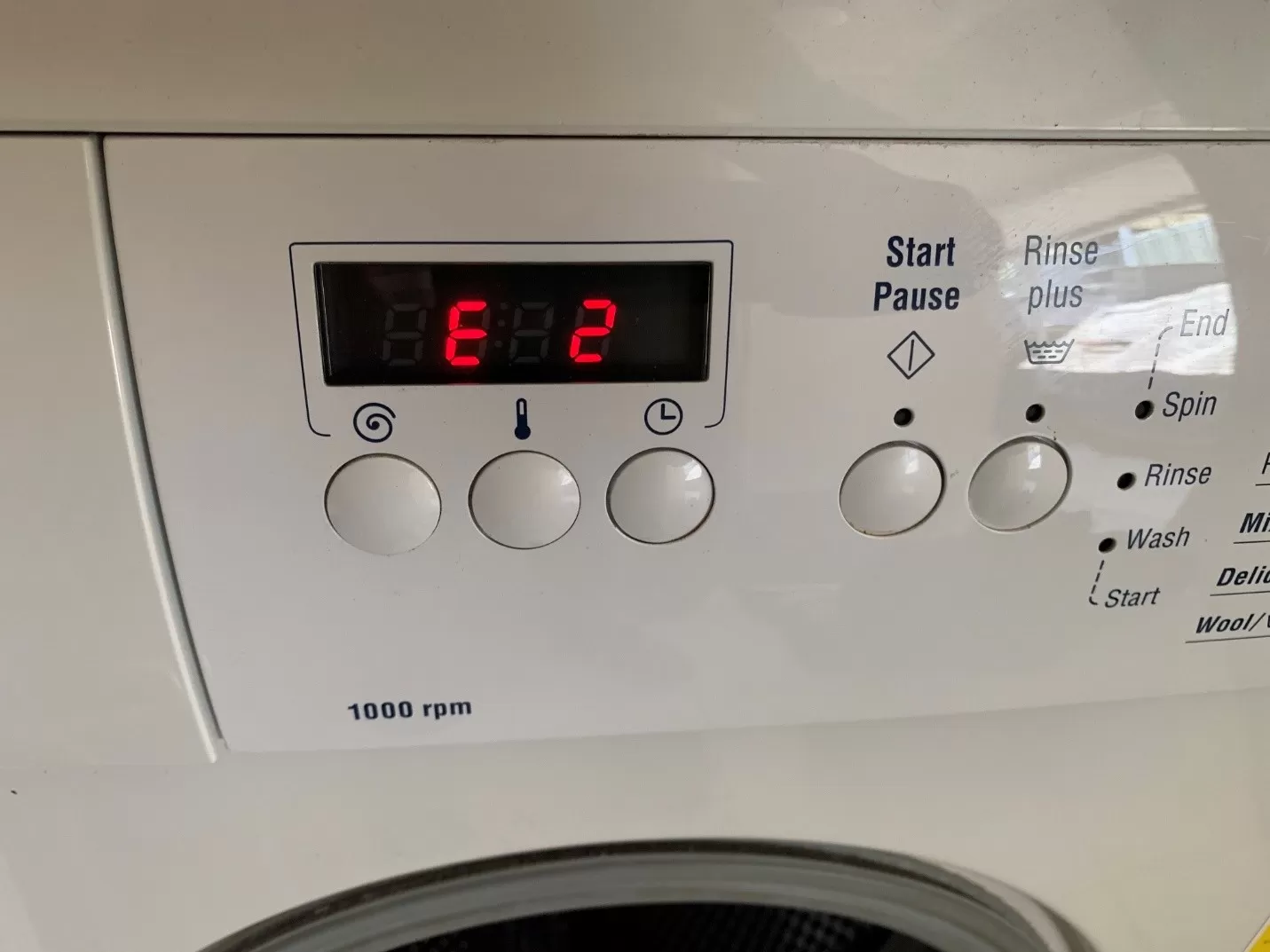
Error Code E02 / F02: Motor Start Fault
This error code signifies a critical electrical or mechanical problem preventing the main drive motor from initiating its rotation, which immediately halts the wash cycle to prevent further damage.
- Symptoms: The drum completely fails to agitate or spin. You will often hear a loud buzzing, clicking, or humming noise from beneath the machine as the motor struggles to engage without any physical movement. In more severe electrical failures, this can be accompanied by a faint burning smell.
-
Cause: For older washing machines utilising traditional brushed motors, this is most commonly caused by severely worn carbon brushes failing to make electrical contact with the commutator. In modern brushless inverter models (such as the EcoSilence Drive), it points to a stalled motor, a failed copper motor winding, or a critical malfunction within the main motor control module causing an abnormal current draw.
-
What to do: Safety is paramount—if you detect a burning electrical smell, switch off the appliance at the power point immediately. Once disconnected, wait a few minutes and try spinning the drum by hand to ensure it is not physically jammed by a trapped item of clothing. While replacing worn carbon brushes is a known fix for older units, diagnosing a blown control board or a shorted motor winding requires the multimeter expertise of a qualified professional.
Error Code E17 / F17: Water Fill Error
This code indicates a critical failure during the water filling stage. The machine has opened its inlet valves but the internal pressure switch has not detected the required volume of water within a strictly programmed timeframe.
-
Symptoms: The cycle halts shortly after starting, and water either trickles in slowly or does not enter the detergent drawer at all.
-
Cause: A blocked inlet filter screen (often due to hard water calcification or municipal sediment), a kinked inlet hose behind the machine, a closed household tap, or a burnt-out inlet solenoid valve.
-
What to do: Turn off the tap and disconnect the inlet hose to inspect and clean the small mesh filter screen with a hard bristle brush. Ensure the tap is fully open and the hose is unkinked. If the physical pathways are clear, a technician will need to test and potentially replace the electronic inlet valve assembly.
Error Code E25 / F25: Turbidity Sensor (AquaSensor) Fault
While the E25 code denotes a mechanical drainage obstruction in Bosch’s dishwashing line, its appearance on a washing machine points to a highly specialised failure within the optical telemetry system—specifically the turbidity sensor, often branded as the AquaSensor. This component is engineered to continuously analyse the optical clarity of the wash water, allowing the microprocessor to algorithmically adjust rinse times and water consumption based on the precise concentration of soil and residual detergent.
-
Symptoms: The washing machine will typically wash normally but exhibit highly erratic behaviour during the rinse phases. Because the machine cannot accurately gauge whether the water is clear, it may become trapped in an infinite rinse loop, repeatedly drawing and expelling fresh water. Eventually, the control board will time out, abort the cycle prematurely, and display the E25 or F25 fault code.
-
Cause: The AquaSensor relies on an internal infrared light emitter and receiver. If the optical lens becomes chronically obscured by a dense accumulation of soap scum, heavy lint, or hard water scale, the light beam is broken, causing the sensor to register the water as perpetually dirty. Alternatively, the sensor’s internal solid-state electronics may have suffered a direct short, or the wiring harness connecting it to the main printed circuit board (PCB) may have fractured due to sustained kinetic vibration from the drum.
-
What to do: The initial diagnostic step is environmental remediation. Run a completely empty maintenance cycle on the highest available temperature setting (e.g., 90°C) alongside a dedicated appliance descaler. This hot chemical wash is designed to strip away any opaque biofilm coating the sensor’s optical lens. If this non-invasive intervention fails to clear the E25/F25 code, the fault is definitively electronic. A professional appliance technician will be required to access the lower tub anatomy, conduct a multimeter continuity test on the wiring harness, and replace the compromised AquaSensor module.
Error Code E19 / F19: Thermal Regulation Exceedance (Heating Fault)
The E19 or F19 error code signifies a critical failure within the machine’s thermal regulation subsystem. Specifically, the microprocessor has detected that the water inside the drum is not heating at the expected algorithmic rate, or the heating phase has entirely exceeded the maximum allowable time limit without reaching the target temperature. The control board initiates this fault to abort the cycle, preventing the machine from continuously drawing high electrical current in a futile and potentially dangerous attempt to heat the water.
-
Symptoms: The wash cycle will often take significantly longer than usual as the machine waits for the temperature to rise, eventually aborting mid-cycle. If the cycle does finish, the laundry will feel completely cold even after a high-temperature wash is selected, and heavy stains or greasy soils will remain largely unresolved. The digital display flashes the E19 or F19 code, typically during the main wash phase when the heater is commanded to engage.
-
Cause: The most probable electromechanical cause is a burnt-out immersion heating element located at the base of the wash tub. This degradation is frequently accelerated in hard water areas, where calcium scale insulates the element and prevents efficient thermal transfer to the water. Alternatively, the NTC (Negative Temperature Coefficient) thermistor—the sensor responsible for monitoring the water temperature—may have failed, sending erratic or zero feedback to the control board. Less commonly, a blown heater relay on the main printed circuit board (PCB) or a fractured wiring harness can sever the power supply to the heater entirely.
-
What to do: Because this fault directly involves the primary high-voltage heating circuit, user intervention is limited. While running a high-temperature maintenance cycle with a commercial descaler can occasionally improve minor calcification issues on a struggling heater, a persistent E19 fault requires a multimeter continuity test. A qualified appliance technician must access the lower drum to test the electrical resistance of both the heating element and the NTC thermistor, replacing the compromised thermal components to restore the machine’s heating capabilities.
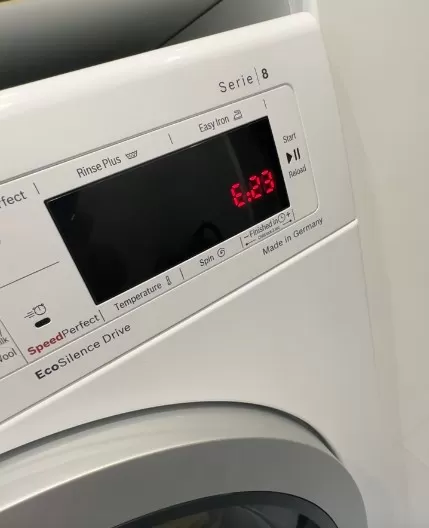
Error Code E23 or F23: AquaStop Hose Activated
The E23 or F23 error code is one of the most critical and time-sensitive faults a Bosch washing machine can display, as it transcends internal operational mechanics and enters the realm of environmental property protection. This specific code indicates that water has escaped the closed hydraulic system of the wash tub and is actively pooling directly on the internal base plate of the appliance, triggering the highly sensitive Electronic Protection System (EPS) or AquaStop float switch.
-
Symptoms: The washing machine shuts down immediately and becomes entirely unresponsive to any user interface commands. The main control board executes an aggressive emergency protocol: it electronically locks the primary water inlet valves closed and hard-wires the drain pump to run continuously (emitting a persistent humming noise) in a desperate attempt to evacuate any remaining water from the drum and mitigate flooding.
-
Cause: A highly buoyant polystyrene disk situated in the lowest recessed tray of the chassis is lifted by the pooling water, which physically engages a microswitch. The origin of the physical leak is typically a degraded or punctured rubber door boot (bellows), a ruptured internal sump hose, a loose detergent dispenser clamp, or severe oversudsing (where excessive foam expands out of the tub and condenses into liquid water on the chassis floor).
-
What to do: The immediate emergency step is to disconnect the appliance entirely from the mains power point. While you can temporarily clear the code by carefully tilting the machine backward at a 45-degree angle to drain the trapped water onto a prepared towel (allowing the float to drop), this is not a permanent fix. Because the physical breach remains, the machine will simply flood again during the next cycle. A forensic inspection by a professional technician is strictly required to unseal the external panels, trace the leak to its source, replace the compromised components, and thoroughly dry the base pan.
Error Code E28 / F28: Flow Sensor (Flow Meter) Fault
The E28 or F28 error code designates a critical communication breakdown within the volumetric water intake system. While the E17 code typically points to a general lack of water reaching the machine, E28 specifically isolates the internal flow sensor (often a Hall-effect or reed switch flow meter). This component is responsible for measuring the precise volume of water entering the machine by generating electrical pulses as the incoming water spins its internal turbine. When the main control board commands the inlet valve to open but receives an erratic, absent, or mathematically impossible pulse count from the flow sensor, it immediately halts the cycle to prevent both dry-running and catastrophic overfilling.
-
Symptoms: The washing machine will typically begin a cycle and you may hear water entering, but the cycle will suddenly abort during this initial fill phase. The machine may exhibit erratic filling behaviour—either severely underfilling or attempting to overfill the drum—before the control board intervenes, shuts off the water valves, and flashes the E28 or F28 code on the display.
-
Cause: The flow sensor’s internal magnetic turbine can become mechanically seized by hard water calcification, fine grit, or municipal sediment that has managed to bypass the primary inlet filters. Alternatively, the solid-state electronic sensor board itself may have suffered a complete component failure, or the delicate wiring harness connecting the flow meter to the main printed circuit board (PCB) has fractured due to sustained kinetic vibration from the drum.
-
What to do: First, verify that your household tap is fully open and the water pressure is strong, as exceptionally low mains pressure can sometimes cause the turbine to spin too slowly for the microprocessor to register. If the external water supply is optimal, the fault is definitively internal. While removing the top panel to inspect the wiring harness for obvious breaks is possible, resolving an E28 fault generally requires a professional appliance technician to conduct a multimeter test on the sensor’s pulse output and replace the faulty flow meter assembly.
Error Code E32: Unbalanced Load (Gyroscopic Imbalance)
Uniquely, E32 rarely indicates a broken part. It is a highly calibrated software intervention designed to save your machine from destroying itself during the high-speed spin cycle.
-
Symptoms: The machine aborts the final high-speed spin, leaving the clothes dripping wet, and flashes E32 (often alternating with “End”).
-
Cause: A single heavy item (like a water-logged bathmat or heavy winter robe) has tangled on one side of the drum, creating a severe centrifugal imbalance. If this code triggers repeatedly on normal, well-balanced loads, the internal shock absorbers (dampers) have likely worn out, allowing the tub to bounce violently.
-
What to do: Pause the machine, untangle the heavy items, and add a few dry towels to counterbalance the weight before restarting the spin cycle. If the machine continues to throw E32 codes on standard mixed loads, the hydraulic shock absorbers at the base of the tub must be replaced.
General Tips for Bosch Laundry Machines
- Check for Blockages: Regularly inspect hoses, filters, and the pump for blockages that could cause drainage issues.
- Balance Loads: Avoid overloading the machine and redistribute clothes evenly to prevent errors.
- Inspect Door Seals: Keep the door seal clean and check for wear to prevent leaks.
- Monitor Heating Elements: Periodically inspect the heating element to ensure proper water heating during cycles.
Resetting Your Bosch Washing Machine
After resolving a physical blockage or replacing a part, you often need to clear the error state from the microprocessor’s memory.
-
Soft Reset: Used for minor glitches. Close the door, press and hold the Start/Reload button for 3 to 5 seconds until the digital display zeros out (e.g.,
0:00or0:01). Allow the machine to run a brief one-minute drain cycle. -
Hard Reset (Power Cycle): Required for deep logic-level faults (like E36 or E23). Completely disconnect the appliance from the mains power point (or switch off the circuit breaker) for 5 to 10 minutes. This allows the main control board capacitors to discharge entirely, wiping transient glitches and forcing a clean reboot.
Struggling to Fix Your Washing Machine Yourself?
While clearing a blocked filter is a straightforward DIY task, diagnosing burnt-out carbon brushes or tracing an internal AquaStop leak requires a professional touch.
If you are located in Adelaide, Wise Appliance Service provides top-of-the-line Bosch appliance repairs across the ACC, Eastern, Inner Northern, Western, Inner Southern, South-Western, and South-Eastern regions. We guarantee access to genuine, affordable spare parts to get your washing machine spinning perfectly again. Just give us a call, and our expert technicians will efficiently resolve any stubborn error codes.